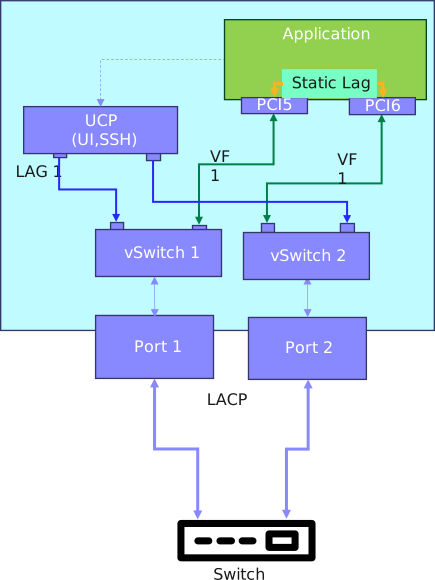
Universal Compute Platform supports the IEEE 802.3ad implementation of Dynamic Link Aggregation Group (LAG), with control managed by the Link Aggregation Control Protocol (LACP). When you join two or more ports into a LAG interface, the network bonds the ports and treats them as a single logical port interface. LAG interfaces increase link throughput and provide redundancy in case of a link failure.
Support includes LACP LAG only for both the host appliance and for the switch that connects to the LAG interface. However, applications that run on the host appliance must use static LAG if they want to deploy LAG. With this architecture:
We recommend that you first configure LACP LAG on both the host appliance and the switch to establish the aggregated link on the physical layer. Static LAG can then be enabled for applications that run on this host that intend to use the LAG interface.
Universal Compute Platform Requirements
Supported LAG port combinations are:
An ICC port and a data port cannot be combined into the same LAG interface.
A single port cannot be added into more than one LAG interface.
The LAG interface inherits VLAN assignments automatically from newly added port members.
Switch Requirements
The switch must be configured with an LACP LAG configuration that includes only the ports that connect directly to the host appliance's LAG interface. LAG failure results if the switch's port setup is incorrect or incomplete.
The switch's LACP expiry timer must be set to 30 seconds to align with Universal Compute Platform's LACP timer setting (long_30).
Application Requirements
For applications that run on the host appliance that want to use the LAG interface, the application requires static LAG with the same port members as the host. Otherwise, the application cannot use the LAG interface or its port members.